Modern living room lighting - tricks and tips
Modern living room lighting - tricks and tips
Light can do wonders in the interior. When necessary, it will emphasize its values or hide unfavorable elements. It can also affect the optical change of the interior's proportions. The number of light points, their type, the intensity of light is important. Thanks to them you can make the room seem higher, wider, more spacious.Lighting in a low living room: if we strongly light the ceiling, that is, we will use a ceiling lamp or hanging lamp with a lampshade or shades facing upwards, the living room will seem taller. Likewise, if we hang a chandelier with the shades facing down, the ceiling will remain in the shade, and the room will appear lower than it actually is. The room will also be higher if we draw up vertical divisions of the walls, for example, columns or pillars.
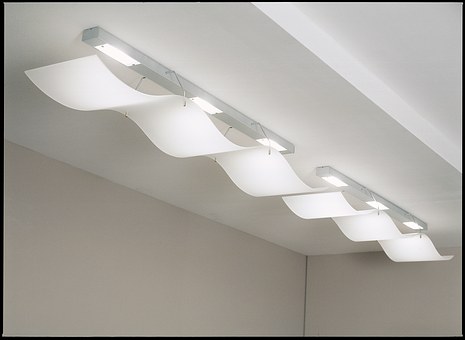
Lighting in a narrow living room: the interior will appear wider if one of its longer walls is lit more than others. A good solution is also the use of light strips on the ceiling or in a break between the ceiling and the wall. It is also worth to highlight the recess or furniture shelf.
Lighting in a small living room: the room will look larger if there are many points of light in it - floor lamps, ceiling sconces. We will optically enlarge the space, spotlighting small elements on the walls such as niches, paintings, and shelves.
Television lighting - how to arrange them?
Although it is the healthiest day to watch TV in daylight, most of us will sit down to our favorite program only when darkness falls. Meanwhile, watching TV in the darkroom torments eyes and is unhealthy for the eyes. When arranging a multimedia corner, one must immediately think about the right lighting. Here are some tips that will help your TV's lighting provide the right mood and at the same time complement the entire living room lighting.The scattered light is best - luminaires with a strong, spotlight are not suitable.
The contrast between the dark interior and the bright screen is offset by the gentle lighting placed near or behind the TV. It is a mistake to set the lamp so that the light beam is reflected on the screen.
Two television sconces placed on the sides of the screen, a lamp mounted in a shelf above the TV, a table lamp placed next to the screen or a floor lamp placed slightly behind the TV will work for the TV's lighting. A good solution is also self-adhesive LED strips that illuminate the recess or TV holder.
The TV set does not have to be very powerful - a 25 W bulb is enough.
Illumination of paintings in the living room
The appearance of graphics depends on the chosen light. That's why the refined lighting of images plays a big role.Luminaires are mounted on the ceiling, walls, above the painting, and on its frame. However, focusing only on the lamp model is not enough. The type of bulb, the angle of incidence of light and the frame in which the picture is framed must be taken into account. Though the frame is being replaced at the end, planning should start from it.
The frame cannot be too thick, because it gives then a large shadow that falls on the canvas and obscures what we want to expose.
If the frame is thin, we can illuminate the image from the wall.
If the frame is of medium thickness - graphics are usually illuminated from the ceiling.
Very thick frames can become a reason to mount the lamp on the frame.
Which bulb should you choose to illuminate the picture?
Light bulbs differ not only in power but also in the color of light. In the case of image illumination, these differences are crucial because each type of light extracts colors from the graphic.An ordinary light bulb emphasizes the warm palette of colors (yellow, red, orange), concealing slightly cool colors (blue, green). As a result, the picture takes on a warmer tone.
The most neutral light, giving a pure white color, is fluorescent light. It best emphasizes the color of the picture. Unfortunately, fluorescent lamps generate a lot of heat during lighting, which in turn may be fatal to the image, so the frame should be placed a considerable distance from the graphic.
Compact fluorescent lamps, i.e. energy-saving bulbs are sold in different colors. Unfortunately, they emit ultraviolet rays that have a devastating effect on images. Therefore, it is better not to use this type of lighting.
Modern LED lighting generates less heat and you can choose the color of the light emitted. Light bulbs are light, so a clip is enough to attach to the frame. They are also small, so you can illuminate them with tight spaces, and the lamp does not divert attention from the picture.
At what angle to illuminate the picture?
Light can have different effects depending on the angle at which it falls on the image. It is considered the best angle of 30 about - at least this position, the light bounces off the canvas and allows the most comfortable to look at the work. The angle can be increased slightly when we have a very wide picture frame and we want to eliminate the shadow falling on the canvas or slightly reduce it when we want to emphasize the texture of the image.The angle of incidence of light is also important in the case of ceiling lighting. Poorly set, it can ruin all efforts. It's enough to stand in front of the picture in the ceiling light area, and we'll start casting a shadow over the picture. The ideal solution is to adjust the angle of the upper light so that it does not interfere with the lighting of the canvas.
Comments
Post a Comment